
Tech Notes · Security
Implementing BIMI email security for your organization
BIMI shows your verified brand logo next to your email in supported clients, signaling that your organization follows email security best practices.
March 6, 2025
BIMI (Brand Indicators for Message Identification) is an email protocol that shows recipients your organization's email is legitimate by displaying your company's logo and a certification mark alongside your message in supported email clients.
Background
The basic protocols for sending and receiving email, solidified in the 1980s, were designed for ease of use and interoperability, not security. That is why, over four decades later, we are still dealing with so much spammy, phishy, spoofy, and fraudulent email in our inboxes.
The largest email providers, including Google, Yahoo, and Microsoft, have used machine learning for years to analyze incoming email and divert as much spam as possible. (Google claims that 99% of all incoming spam is removed before it even reaches your spam folder, so you never see it.) But those incoming filters are constantly being challenged, and can be overzealous and tag legitimate email as spam.
Setting outgoing email security policies
Organizations can create email security policies that give recipient email servers specific instructions about what to do with mail that comes from, or looks like it comes from, their domain.
- SPF (Sender Policy Framework) and DKIM (Domain Keys Identified Mail) domain records validate legitimate mail from a specific domain.
- DMARC (Domain-based Message Authentication Reporting and Conformance) policies give recipient mail servers specific instructions for how to handle mail that does not validate with SPF or DKIM.
Email providers like Google and Yahoo are pushing hard for organizations to adopt these email security policies and make it easier to smoke out the fraudsters. Macktez has supported many of our clients' efforts to maintain up-to-date email security policies and review DMARC deliverability reports to confirm ongoing compliance through our Domain Management subscription.
Adding message branding
Organizations can now build on SPF, DKIM, and DMARC to give recipients a clear, visual indication that they are following email security best practices and that their email cannot be spoofed. BIMI lets an email with SPF and DKIM validation and a strong DMARC policy display visual verification of legitimacy: a brand logo and a certificate checkmark.
With visible marks of authenticity, recipients know that security policies are being followed behind the scenes, have higher confidence in the messages that reach their inboxes, and are more likely to read and respond.
For organizations that rely on outgoing email for marketing and customer service, that visible mark of trust supports brand identity and online reputation. But even for companies that are not running active email marketing campaigns, BIMI sends an important signal to clients, colleagues, and vendors that they take email security seriously.
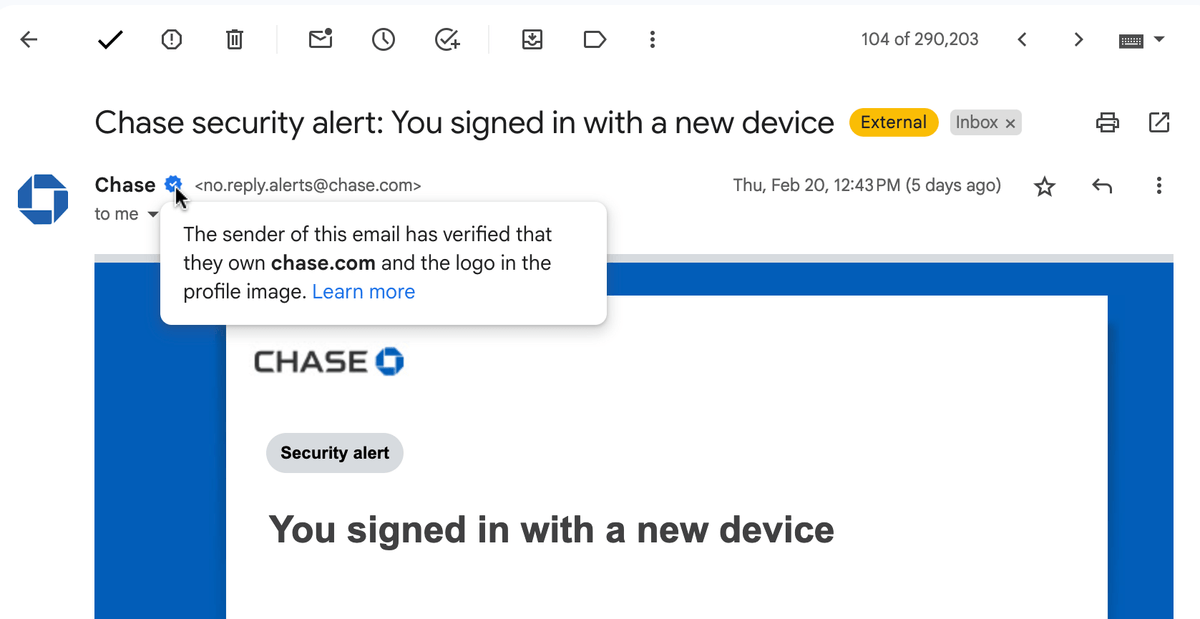
BIMI verification as it appears in Gmail today.
More and more email clients are supporting these BIMI-verified brand logos in the email list view, not only after opening an email, including Apple Mail in iOS 18. That will make the benefits of BIMI more visible to more people in 2025.
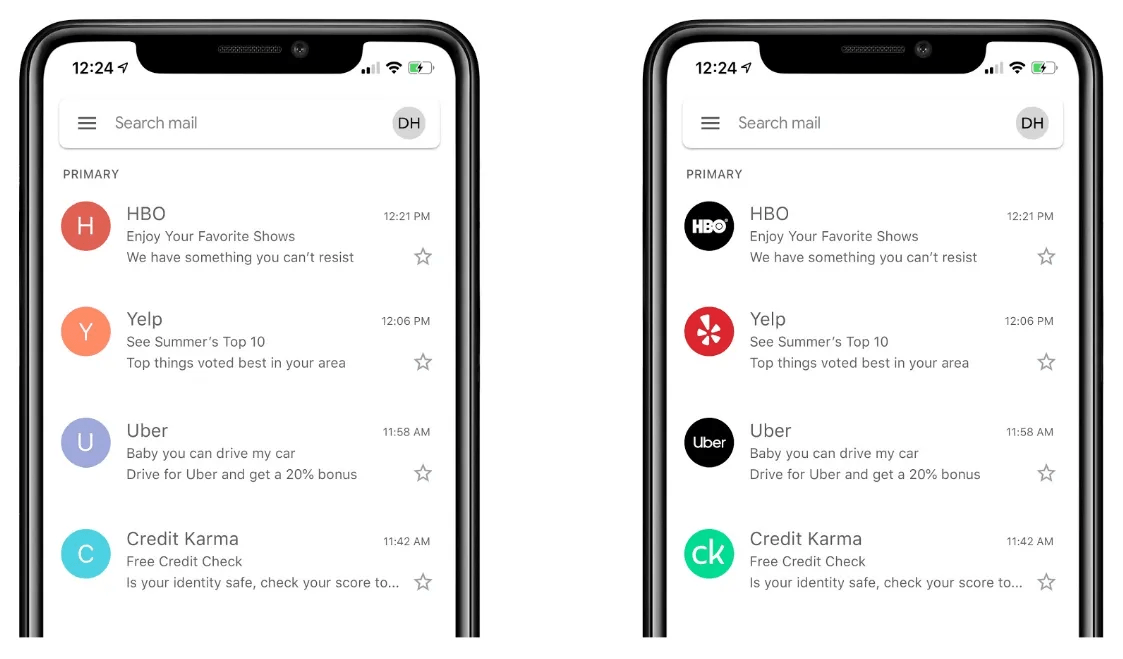
Example of what an email client can look like with BIMI (credit: Mailhardener).
Implementation of BIMI
Organizations need a few things in place to implement BIMI for their domain:
- SPF and DKIM records that authenticate valid domain emails.
- A strong DMARC policy set to quarantine or reject 100% of email that does not pass SPF or DKIM verification.
- A registered trademark or distinguishable brand logo.
You then purchase a particular type of domain certificate depending on whether the organization's logo is registered, and set up additional domain security records to tie all these pieces together and deliver the logo to recipients' inboxes.
BIMI's key benefits
- Visual indication of security: The logo and checkmark displayed next to emails highlight the legitimacy of the email, backed by email security standards.
- Increased brand recognition: BIMI lets businesses display their verified brand logo alongside their emails instead of generic icons.
- Protection against phishing and spoofing: Attackers cannot impersonate the brand logo that accompanies emails, making their attempts to spoof a domain much less likely to succeed.
Any drawbacks?
The security and branding benefits come with some challenges:
- Complexity: Implementing BIMI requires coordination between multiple teams, including IT, marketing, and security.
- Technical expertise: Getting to the required level of DMARC policy takes time to monitor deliverability reports, adjust domain records, and gradually strengthen email security policies.
- Ongoing maintenance: BIMI requires ongoing maintenance of email security policies to ensure that your brand logo displays correctly and that your DNS records stay up to date.
- Cost: The required domain certificates cost $1,200 to $1,600 per year, and ongoing DMARC monitoring requires a third-party service.
- Email client support: BIMI is not yet supported by all email clients, notably Microsoft Outlook. Some recipients may not yet see verified brand logos.
Macktez has extensive experience with domain security records, DMARC policies, and certificate acquisition. Reach out if you are interested in getting this process in motion.