Tête-à-Tech: Art and Money Need Not be Strange Bedfellows
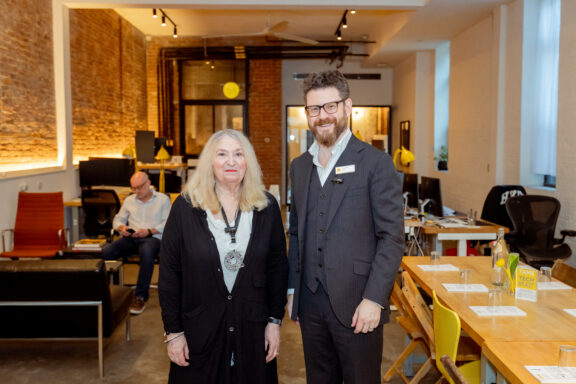
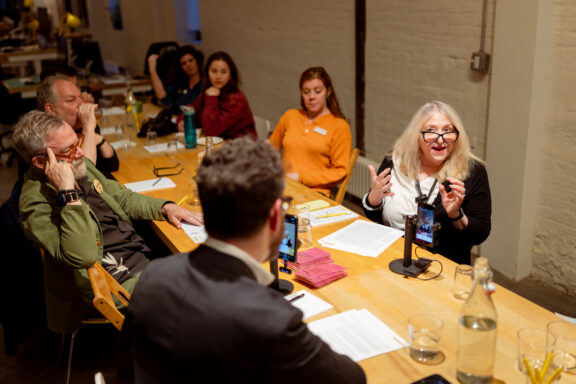
On May 7, 2026, the Macktez office was packed for our Tête-à-Tech with Ruby Lerner (Founder, Creative Capital) and Noah Landow (Founder and CEO at Macktez), humming with the energy of a community hungry for connection.
Under Ruby’s radical leadership, Creative Capital turned traditional arts philanthropy on its head, pioneering a venture-capital-style model that committed over $40 million in funding and advisory support, ultimately helping artists leverage nearly $100 million in additional resources.
That evening, we came together to explore how art and money can productively coexist, move past the tired myth that money is the root of all evil, and dig into what it truly means for a creator to achieve creative sovereignty. Here are the highlights:
Dismantling the “Here’s a Check, Send Us a Report” Philanthropy
When Creative Capital was formed during the brutal culture war years of the late 1990s, the National Endowment for the Arts had stopped funding individual artists’ projects. Traditional philanthropy was passive. Ruby and her team wanted something radically different, they looked to the multifaceted approach that Silicon Valley tech investors used to build young businesses.
I didn’t know, as we say in the South, I didn’t know doodly squat about venture capital or venture philanthropy, but I was fascinated by it. Traditional philanthropy is what I call the ‘here’s a check, send us a report’ model. They thought, ‘Well, who would do business this way? This is crazy.
Creative Capital introduced a model where a $50,000 award wasn’t just handed over as a lump sum; it was parsed out through the life of the project according to strict benchmarks, backed by intensive professional development, community building, and public promotion.
When Noah asked what part of this systematic setup made traditional donors nervous, Ruby didn’t hesitate. She said it was everything, everything made them nervous.
The Lie of the “Discovered” Artist
One of the greatest disservices done to creators is the romanticized idea that genius is simply “discovered” without any business acumen. Ruby pulled no punches when discussing how higher education fails to prepare students for the real world, heavily critiquing art schools who do not teach financial literacy.
Artist training hasn’t helped this because, you know, there’s some weird attitude that if you’re really great, you’re going to get discovered… We spent a lot of time at Creative Capital talking to schools. The barrier? The faculty. They called it vocational training. They didn’t think it should be happening in the art school. I’m like, God, that is horrible!
Flipping the Script on Money
In response to Noah’s question, “why do you think artists are so, generally and universally complicated, conflicted, sort of tortured by their relationship to money?” Ruby traced it back to a fundamental misinterpretation of a famous biblical text, urging creators to reclaim financial power as a tool for personal freedom and collective resistance:
We’ve internalized that biblical quote, that money’s the root of all evil. But that is not the actual quote. The actual quote is the love of money is the root of all evil. And that is a completely different proposition, right? My personal feeling is we need resources to counter all the assholes that are out there. So greed is bad, yes, but money can mean personal freedom and generosity to others.
The Reality of Creative Sovereignty: Stop Renting Your Audience
In a digital landscape dominated by algorithmic platforms, Ruby introduced a powerful warning about building your creative house on land you don’t own. True creative sovereignty requires owning your data and your direct relationships.
When somebody tells me, ‘Oh, but I have a lot of people on Instagram or Facebook,’ it’s like, I’m sorry, no. That’s just not good enough. You don’t own that. You don’t control the algorithm. They can change it on you overnight, and you don’t get a vote.
Relying on social media means you are essentially sharecropping data for the big media companies. Instead, her ultimate solution is a direct line of communication: the mailing list. As a self-proclaimed “mailing list freak” for over 40 years, Ruby insists that everyone needs an independent web presence to maintain a true, unmediated community.
She also challenged performing and visual artists to think pragmatically and build audience data collection directly into their exhibition and venue contracts from day one, rather than begging for information at the end of a show. She warned that selling out three nights in Milwaukee with standing ovations isn’t enough if you don’t know who those 1,500 adoring audience members are. That disconnect is unsustainable, artists can’t afford to lose 1,500 people who just saw their work, loved it, and gave them standing ovations every night.
Practical Advice for Creative Financial Literacy
For those wondering how to practically transition out of financial precarity, Ruby’s advice was grounded in absolute reality: look at your numbers, write down your goals, and stop “winging it.”
Write it down: You are up to 42% more likely to achieve your goals if you just write them down. There’s something built into that process of self-articulation where you put something on paper, you can see it, and that makes it tangible for you.
Confront your debt: Calculate your net worth at least once or twice a year. What is net worth is just subtracting what you owe from what you own. Pretty simple. If you’re in debt, don’t try to run from it, confront it, and make a plan for debt reduction.
Pay yourself first: Financial advisors educate you to pay yourself first. This means sucking away a small percentage of everything you’re bringing in. If you’re a freelancer, just make a commitment to put it away, because with inflation, it’s very likely that Social Security or a basic retirement account just will not be enough down the road.
Never phone it in: If you get an opportunity, never phone it in. You’re never better if you just wing it. Plan, be prepared. It’s rude not to be prepared.
The Urgency of Saving Your History
In an era where institutional funding structures are fracturing, Ruby concluded with a plea for artists to fiercely preserve their own legacies. If creators don’t actively chronicle their journeys, their contributions risk being erased by the mainstream.
She emphasized that for those outside the mainstream, which is really almost everybody, it’s even more critical to tell our own stories, because many people want to erase them. We must chronicle ourselves, because if we don’t, we will be disappeared.
As Noah insightfully noted to close the conversation, the best time to start planning your legacy was at the beginning of your career, but the second best time is now. To leave the room inspired, Ruby issued a final challenge:
“What is one generous act you can do individually in the next week? And can you come together with colleagues you respect to solve a small problem and create something new together?”
Because, as Ruby beautifully reminded us all, generosity is a mind-altering drug.