
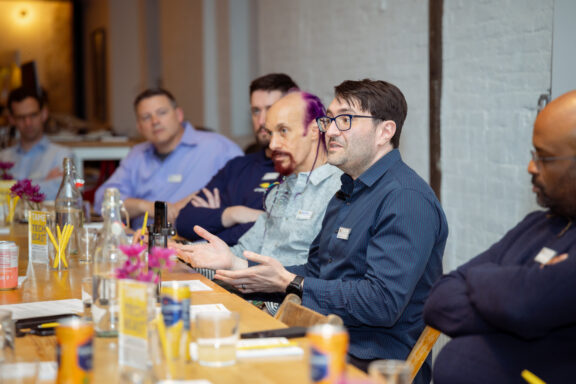
On April 23rd, 2026, Jeffrey Berger, PhD. a theoretical physicist joined Noah Landow, Macktez Founder and CEO for a “Tête-à-Tech” conversation entitled AI and Consciousness: What Is Actually Happening In There (According to Mathematics)?
Berger doesn’t look at AI like a typical software developer; he looks at it like a reductionist who prefers to re-derive the laws of the universe on the fly.
Physicists are famously reductionists… I’ll just re-derive whatever escape velocity is, I’m not gonna remember it. I’m always interested in the underlying behavior of the system.”
He traced the lineage of AI from the 1960s to the 2017 Google paper “Attention is All You Need”, which introduced the Transformer architecture. While the world saw magic, Berger initially saw a “parlor trick,” and recalled his early skepticism.
One of the most provocative moments of the evening came when the discussion turned to whether these machines are actually thinking. For Berger, the distinction between knowledge and intelligence is a hard line.
You shouldn’t confuse intelligence and knowledge, he argued. A book can be extremely knowledgeable, but no one’s going to say the book’s intelligent… Knowledge can come from intelligence, but intelligence can’t come from knowledge. It’s kind of like you’re mistaking a jug of milk for a cow.
When modern AI models “think,” Berger explained they are essentially talking to themselves, generating intermediate tokens to narrow down a probability space. This led to the “ten trillion dollar question” of whether we are hitting a ceiling in AI capability due to data poisoning. Berger compared the current state of the internet to the atmosphere after the nuclear tests of the 1950s.
The conversation eventually shifted into the metaphysical. Berger referenced the theory that consciousness might be a quantum effect, something deep within the nuclear spin of atoms, which would mean classical computers are fundamentally incapable of achieving it.
As the evening wrapped up, Berger offered a final perspective that was both pragmatic and, as Noah joked, a bit “dark.” He urged the audience to use AI for what it is,
Go forth and use your AIs and don’t feel like you have to thank it because it doesn’t have feelings,” he concluded. “The machine will tell you ‘I’m not just a machine,’ but it’s just because it’s been trained to say that.” He even suggested that being polite might be a waste of time: “There’s plenty of papers that you can look at that shows you can get better performance by being rude. So you can just tell it that it’s an idiot too. It’s not gonna hurt it.”
Origins of Machine Learning
Jeffrey Berger, Ph.D. and Noah Landow break down why AI isn’t new, it dates back to the 1940s–60s with early neural network work and the perceptron. They explain how the 1980s breakthrough of backpropagation enabled deeper networks with hidden layers, turning theoretical AI into real deep learning.
Turning Point for AI
Jeffrey Berger, Ph.D. and Noah Landow unpack the real turning point in modern AI, from the leap in Google Translate to the breakthrough “Attention Is All You Need” paper. They trace how transformer architecture led directly to ChatGPT and why it felt like AI appeared overnight.
AI as Intelligent
Jeffrey Berger, Ph.D. and Noah Landow explore what AI is actually doing when it says it’s “thinking.” They break down how models build a context window from your prompts, shift from zero-shot responses to intermediate reasoning, and use techniques like the DeepSeek R1 approach to “talk to itself” before generating answers.